"Microdosing" Exercise throughout the Day--Ascendent but Not New
Grease the Groove—Promoted to Requirement

Introduction
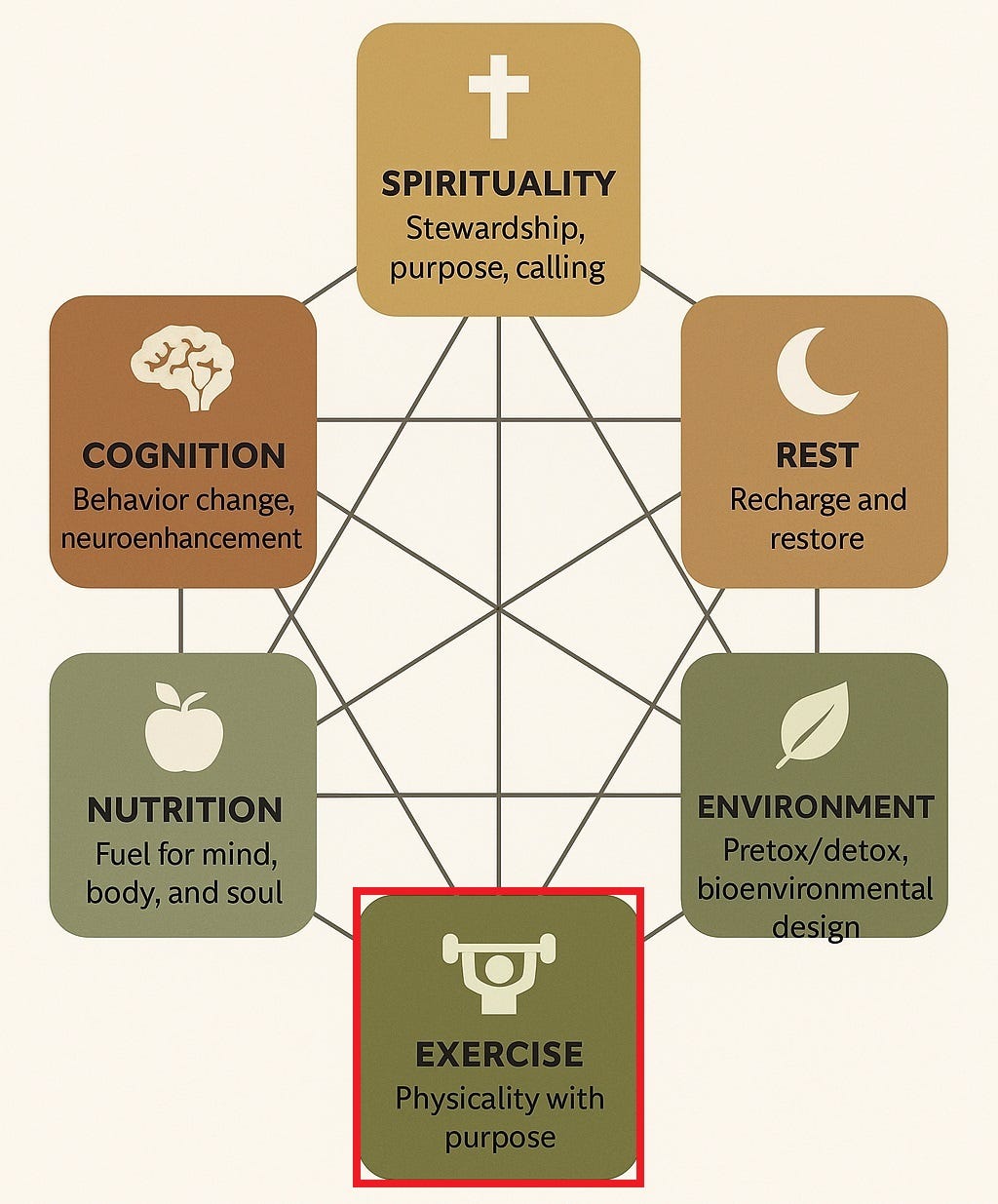
This article addresses the Exercise component of the SCREEN framework and Grease-the-Groove (GTG) specifically.
GTG has been a staple of my fitness routine for several years. It involves executing two exercises, one upper body (e.g., pullup) and one lower body (e.g., pistol squat), at low intensity and low volume frequently throughout the day. I do GTG every hour on the hour to keep it simple. See Pavel’s The Naked Warrior (2004) for more on GTG [1] and its benefits for strength. The genesis of this post was an idea that I broached at a StrongFirst PlanStrong seminar about writing a blog post on how I have used GTG to rehab injuries, specifically, two shoulder surgeries, one hip surgery, and a partial rotator cuff tear that did not require surgery but nonetheless set me back a year and a half.
After much procrastination, I am finally writing the post but expanding it. GTG is great for rehab, but my thinking has evolved to the point in which I recommend that everyone should do GTG all the time, regardless of circumstances. That evolution was the result of several revelations:
We are always rehabbing or “prehabbing” something
GTG is an ideal format for building strength
Strength is a vital component of health and longevity—not just athletic performance
GTG mimics activity patterns in ancestral and high-longevity peoples
We always should be “a little warm” for whatever life brings
The Injury-Return-to-Play Continuum
First, the disclaimer: I am not a doctor. I do not diagnose or treat injuries. If you suspect an injury, you should first consult a chiropractor or physical therapist. StrongFirst boasts several doctors of chiropractic medicine, including Master Instructor Michael Hartle and Senior Instructor Prentiss Rhodes. Medical doctors (MDs) have their place, but they are not a good first stop for musculoskeletal injuries unless something is obviously broken, torn, or infected.
In reality, recovery exists on a continuum from the acute injury event, the medical intervention (which could be anything from rest to surgery), formal rehab by a physical therapist, resumption of strength and conditioning training, return-to-play (RTP), and ongoing prehab or preventative maintenance, and it is not clear where one ends, the others begin, or even if they are always distinct. Insurance coverage for rehab sessions is finite, and that number only seems to decrease. Also, the needs of an athlete seeking to RTP after a major injury are often far more extensive than those of someone who just wants to return to his occupation and resume the activities of daily living (ADL).
Some of the RTP protocols for determining when an athlete is ready to RTP are laughable. Return to pre-injury functionality? The level of pre-injury functionality is what led to the injury, so that is obviously not adequate. Percentage of strength and mobility of the non-op limb? What is to say that that limb is not the next in line for an injury and surgery, ditto. The only relevant RTP protocol is the requirements for the sport, and when we are being honest with ourselves, those can be far more rigorous than current RTP requirements and can take a long time to acquire or reacquire after an injury, and most of that work will take place after the medical intervention and formal rehabilitation. In short, whether we are doctors or not, the burden of restoring and surpassing pre-injury functionality is going to fall on us as injured athletes and as those who coach injured athletes whether or not it falls within our scope of practice.
The best practice is to work in interdisciplinary teams to service athletes: strength and conditioning coaches, MDs, chiropractors, physical therapists, nutritionists, sports scientists, psychologists, trainers, and massage therapists. That is the model that was used by the Oklahoma City Thunder to achieve a record low number of games missed due to injury, 158 during the period 2016-2018. To put that in perspective, that was almost one standard deviation better than the second-best team (301) in the NBA and over two standard deviations better than the league average of 488 (standard deviation 156) [2]. Unfortunately, that model is not universal because of a combination of ignorance, obstinance, or simple lack of resources, especially outside of the professional ranks. In short, work with others when possible and do the best you can safely when working alone.
GTG for Rehab and Prehab
GTG is ideal for rehab because of the low volume, low intensity, and high frequency. Strength coaches were in the vanguard of recognizing the importance of performing rehabilitation exercises frequently [3]. Doing so increases blood flow to the injured tissues, prevents adhesions and scar tissue from forming, replaces and reforms scar tissue with functional tissue, and retrains the nervous system. The question then becomes when rehab ends? It does not. The joke is: how long do I have to rehab the limb?—as long as you want to continue to use it.
GTG for Strength
The nervous system and tissue architecture benefits of GTG for rehab should not be surprising given GTG’s benefits for strength. Hypertrophy or muscle growth is only one component of strength, tissue architecture and nervous system adaptations being the other two. Repeating similar lifts frequently reinforces those tissue and nervous system adaptations. The architecture benefits come from the tendency of tissue shape and direction to change in response to repeated exposure to similar stresses [4]. The nervous system adaptations appear to come from three sources: chunking, distributed versus massed learning, and motor unit recruitment.
GTG and the Neuromuscular Nexus
Regarding chunking, the limits of working memory are from four to seven pieces of information [5, 6]; however, experts group or “chunk” information together differently—better—than novices, allowing them to keep more information in working memory while remaining with the confines of the four-to-seven constraint [7]. That is how expert coaches can eyeball a movement and see what the athlete did right and wrong while novice coaches miss things because they can only focus on granular components: an ankle, a knee, the hips, etc. Chunking’s relevance to strength is that with practice athletes can keep more aspects of a complex strength movement in their heads simultaneously and free up working memory to focus on specific areas of improvement [8].
Distributed learning, learning a skill in small quantities at a time over frequent intervals, facilitates chunking and skill acquisition generally. The opposite of distributed learning is massed learning, trying to do it all in one session—cramming. The former is superior to the latter, which is intuitively obvious to anyone who has pulled an all-nighter. The superiority of distributed learning over massed learning was first described by Ebbinghaus in 1885 [9] and has been affirmed by recent meta-analyses specific to the domain of psychomotor skills [10, 11]. Strength is a skill and skills require training. Strength is not exercise. Exercise is what the American Heart Association wants you to do—move around and get sweaty. Training is “physical activity performed for purposes of satisfying a long-term performance goal” [12]—getting stronger.
Regarding motor unit recruitment, the effects of frequent training are unambiguous. Frequency decreases agonist coactivation and increases the number of units recruited, firing synchronicity, and firing frequency [13]; however, the mechanism behind those nervous system adaptations and the cognitive adaptations mentioned previously are unclear. Increased myelination is the popular explanation and it appears to have some merit according to the literature review by Bloom et al. [14]. The authors of that review noted that adaptive myelination occurs in response to novel, complex tasks and that those effects dwindled soon after introduction of the novel task and did not recur when the task was reintroduced. How those results translate from wheel running in mice to human strength training is unclear. The topic is ripe for additional research.
GTG for Strength and Strength for Health
Having established GTG’s impact on strength, the next step in establishing the GTG-health nexus is to establish the relationship between strength and health. A meta-analysis of 39 studies with 39,852 total participants found a relationship between strength and mortality after controlling for sex, BMI, physical activity, and smoking [15]. The mechanisms likely include: decreased risk of falling and accidents due to increased ability to balance and preservation of fast twitch muscle fibers, increased resiliency from falls and accidents due to increased bone mineral density, decreased risk of cardiovascular and metabolic disease due to increased insulin sensitivity, and the emotional and social benefits of being able to maintain an active life with friends and family well into old age.
In addition to GTG’s impact on strength and strength’s independent impact on longevity, GTG mimics ancestral activity patterns as well as those that exist in current “blue zones” or regions where individuals routinely live longer, healthier lives than the rest of the world. In those times and in those regions, individuals have engaged in frequent, low intensity physical activity throughout the day [16]. Distributed exercise is qualitatively different from massed exercise. It is not possible to sit all day and then negate the harmful effects of sitting by going to the gym after work [17]. That is like smoking crack cocaine at lunch and then expecting to undo the damage by having a healthy salad for dinner.
GTG as Warmup for Life
The last reason why we should all do some form of GTG all the time is that we should always be “a little warm.” If I get jumped in the parking lot coming out of the grocery store or if I need to jump out of the way of an oncoming inattentive driver, I will not get a chance to warm up beforehand. Like a quick reaction flight crew that sleeps with its gear on while their bombers idle on the runway, we always should be a little warm for whatever life brings.
References
[1] P. Tsatsouline, The Naked Warrior: Master the Secrets of the Super-strong, Using Bodyweight Exercises Only. Dragon Door Publications, 2004.
[2] A. Paul. "The Intersection of Therapy and Performance with the Oklahoma City Thunder." https://www.nsca.com/education/videos/the-intersection-of-therapy-and-performance-with-the-oklahoma-city-thunder/ (accessed March 19, 2025).
[3] B. Starr, The Strongest Shall Survive. Sheridan Books, 1999. 1976.
[4] M. Israetal. "How Hypertrophy and Strength Training Differ: Make Sure You Get the Best of Both." https://www.nsca.tv/videos/mike-israetel-national-2021-how-hypertrophy-and-strength-training-differ-and-how-you-can-make-sure-to-get-the-best-of-both (accessed March 24, 2025).
[5] N. Cowan, "The magical number 4 in short-term memory: a reconsideration of mental storage capacity," (in eng), Behav Brain Sci, vol. 24, no. 1, pp. 87-114; discussion 114-85, Feb 2001, doi: 10.1017/s0140525x01003922.
[6] G. A. Miller, "The magical number seven plus or minus two: some limits on our capacity for processing information," (in eng), Psychol Rev, vol. 63, no. 2, pp. 81-97, Mar 1956.
[7] W. G. Chase and H. A. Simon, "Perception in chess," Cognitive Psychology, vol. 4, no. 1, pp. 55-81, 1973/01/01/ 1973, doi: https://doi.org/10.1016/0010-0285(73)90004-2.
[8] J. Sweller, "Cognitive Load During Problem Solving: Effects on Learning," Cognitive Science, vol. 12, no. 2, pp. 257-285, 1988.
[9] H. L. Roediger, "Remembering Ebbinghaus," Contemporary Psychology: A Journal of Reviews, vol. 30, no. 7, pp. 519-523, 1985, doi: 10.1037/023895.
[10] J. J. Donovan and D. J. Radosevich, "A meta-analytic review of the distribution of practice effect: Now you see it, now you don't," Journal of Applied Psychology, vol. 84, no. 5, pp. 795-805, 1999, doi: 10.1037/0021-9010.84.5.795.
[11] T. D. Lee and E. D. Genovese, "Distribution of practice in motor skill acquisition: Learning and performance effects reconsidered," Research Quarterly for Exercise and Sport, vol. 59, no. 4, pp. 277-287, 1988, doi: 10.1080/02701367.1988.10609373.
[12] M. Rippetoe and A. Baker, Practical Programming for Strength Training, 3rd ed. Wichita Falls, TX: The Aasgaard Company, 2013.
[13] B. J. Schoenfeld, Science and Development of Muscle Hypertrophy. Human Kinetics, 2020.
[14] M. S. Bloom, J. Orthmann-Murphy, and J. B. Grinspan, "Motor Learning and Physical Exercise in Adaptive Myelination and Remyelination," (in eng), ASN Neuro, vol. 14, p. 17590914221097510, Jan-Dec 2022, doi: 10.1177/17590914221097510.
[15] C. Jochem, M. Leitzmann, K. Volaklis, D. Aune, and B. Strasser, "Association Between Muscular Strength and Mortality in Clinical Populations: A Systematic Review and Meta-Analysis," Journal of the American Medical Directors Association, vol. 20, no. 10, pp. 1213-1223, 2019, doi: 10.1016/j.jamda.2019.05.015.
[16] B. Greenfield, Boundless: Upgrade Your Brain, Optimize Your Body & Defy Aging. Victory Belt Publishing, 2020.
[17] K. Starrett and G. Cordoza, Deskbound: Standing Up to a Sitting World. Victory Belt Publishing, 2016.