Complexity and Cognitive Biases in Health & Performance
In Memory of Pioneering Cognitive Scientist Dr. Paul J. Feltovich

I retired from my 20-year career in banking to do men’s health & performance full time last year. That transition had been in the works for over a decade, but the final decision was precipitated by two events, the death of my father and my health & performance framework, the SCREEN Framework, becoming ripe enough for wider dissemination, two subjects that are core to this article.
My SCREEN Framework finally identifies and integrates six mutually exclusive, collectively exhaustive, interrelated, and interdependent pillars of health & performance: Spirituality, Cognition, Recovery, Environment, Exercise, and Nutrition. I thought—naively—that the Framework would be a welcome addition to the health & performance canon, but the reception has ranged from indifferent to ambivalent to outright hostile.
That reaction puzzled me until I thought back to one of my late father’s many contributions to the field of cognitive science, his own framework for describing the dimensions of conceptual difficulty—and the biases that cause people to misunderstand or misinterpret complex phenomena [1].
His work clarified the sources of the dissonance between my lofty perception of the SCREEN Framework and its underwhelming reception—humans don’t do complexity well—which helps explain the tendency to try to reduce every complex phenomenon into something that fits on a bumper sticker. Instead of surrendering to the mob and stickerizing my Framework, I resolved on the one-year anniversary of his death to take up his mantle and use his Framework to help spread mine.
In his seminal paper, my late father, Paul J. Feltovich, along with authors Robert R. Hoffman, David Woods, Axel Roesler, identified and described 11 dimensions of conceptual difficulty:
Static vs. dynamic
Discrete vs. continuous
Separable vs. interactive
Sequential vs. simultaneous
Homogeneous vs. heterogeneous
Single vs. multiple representations
Mechanism vs. organism
Linear vs. non-linear
Universal vs. conditional
Regular vs. irregular
Surface vs. deep
A full description of how health & performance falls along those dimensions is beyond the scope of this humble work but will be explored more fully in my upcoming book, Eudaimonia I: Exodus, set for release in late 2026. For this more modest work, a few examples of how reductive biases apply to health & performance concepts shall suffice.
Static vs. dynamic: “Are important aspects of a situation captured by a fixed ‘snapshot,’ or are the critical characteristics captured only by the changes from frame to frame?”
Discrete vs. continuous: “Do processes proceed in discernable steps, or are they unbreakable continua?”
These reductive biases arise frequently in the context of biomarkers in blood work and other lab tests. Often, results are interpreted in binary terms—normal or clinically significant—and treated as static snapshots rather than dynamic, continuous processes. That unfortunate tendency has been noted by Dr. Shawn Arent, professor and Chair of the Department of Exercise Science in the Arnold School of Public Health at the University of South Carolina and former president of the International Society of Sports Nutrition. In his work with athlete biomarker panels, Arent has emphasized that an “in-range” lab value tells you almost nothing in isolation [2]. What matters is how that marker behaves over time in the context of training load, recovery, and performance. He has designed and led studies that measure biomarkers across a season and analyzed the trajectory of hormones, inflammatory markers, and other labs. For example, in a study tracking Division I female soccer players, ferritin (iron) levels remained technically “in range” throughout the season while declining 35% from baseline—a continuous deterioration that discrete categorical thinking would miss entirely. In his research, conference presentations, and social media, he emphasizes that biomarkers are only useful when you stop treating them like a static pass/fail report card and start recognizing them as the dynamic, context-dependent, continuous processes they are, replete with noisy inputs and feedback loops.
Separable vs. interactive: “Do processes occur independently or with only weak interaction, or do strong interaction and interdependence exist?”
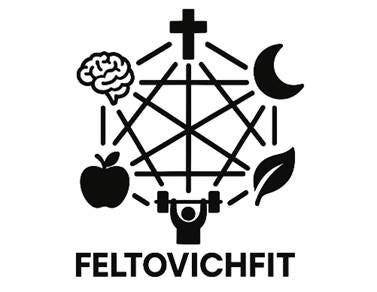
This dimension is the foundational premise of the SCREEN Framework and its symbol (Figure 1). The term “pillar” for each component was deliberate too. Like pillars supporting a building, you can’t arbitrarily choose which ones to keep and which ones to remove—at least not if you don’t want the entire edifice to collapse. The Framework arose because debates about the relative importance of each pillar invariably deteriorated into “chicken or egg” riddles with no resolution. Attempts to optimize one pillar without consideration of the others proved equally futile.
Figure 1: FELTOVICHFIT symbol
One of the most glaring and underappreciated examples comes from the Environment pillar and Dr. Neil Nathan’s work on toxicity [3]. Toxicity—including heavy metals, mold, volatile organic compounds (VOCs), and herbicides, just to name a few—often exacts its toll at the foundational building block of life and its means of interacting with its external environment: the cell membrane. Without functioning cell membranes, every physiological process in each of the other pillars is prima facie implicated. And with the other five pillars impaired, man’s relationship with his Creator—the Spirituality pillar—probably wouldn’t be functioning optimally either.
Sequential vs. simultaneous: “Do processes occur one at a time, or do multiple processes occur at the same time?”
Homogeneous vs. heterogeneous: “Are components or explanatory schemes uniform (or similar) across a system, or are they diverse?”
There is also a tendency to think of recovery between training sessions as a binary yes/no question: is the trainee recovered, or isn’t he? The reality is far more complicated. That becomes evident even from examining the acute stresses and adaptations arising from a single intense resistance training session. There might be central nervous system (CNS) fatigue from heavy squats or deadlifts. There might be muscle glycogen depletion from high-repetition sets. There might be exercise-induced muscle damage (EIMD) from heavy eccentric or negative repetitions. Those stresses and their corresponding adaptations occur simultaneously and are heterogeneous in their recovery timelines. CNS fatigue might take several days to resolve, which is why powerlifters often separate heavy lifting sessions by several days even if the lifts involve different body parts. Glycogen depletion can be resolved rapidly through nutrition, which is why Tour de France cyclists in the multi-day event can bike up and down mountains all day with their heart rates at 180 beats per minute, consume 10,000 calories for dinner, and be ready to race again the next day. Of the acute stresses mentioned, EIMD takes the longest to recover from, which is why bodybuilders using heavy eccentrics might train each muscle group only once per week. That phenomenon of differing timelines is often referred to as the heterochronicity of adaptations.
The chronic or longer-term adaptations from such training such as mitochondrial biogenesis and muscle hypertrophy, or muscle growth, are likewise simultaneous and heterogeneous, which is why trainees notice their endurance increase long before they see their muscles start to grow, and also why muscle mass persists after training cessation long after endurance has returned to baseline.
Single vs. multiple representations: “Do elements in a situation afford single or just a few interpretations, functional uses, categorizations, and so on, or do they afford many?”
Mechanism vs. organicism: “Are effects traceable to simple and direct causal agents, or are they the product of more systemwide, organic functions?”
The classic example of biases related to those dimensions is cardiovascular disease (CVD) and was in fact the subject of one of my father’s earlier papers [4]. The dominant model in Western medicine has been to treat CVD like a plumbing problem: CVD occurs when the pipes get clogged. Ergo, the solution is to minimize the pipe-clogging substrate, cholesterol, with diet and statins, reduce the pressure in the pipes with antihypertensive medications, and widen the pipes when they start to clog with stents—a nice, tidy model easily understandable to anyone who’s ever had a clogged toilet.
That mechanistic, single-representation approach has delivered the outcomes one would expect from reductive thinking at the scale of the pharmaceutical-sickcare industrial complex that funds it: massive resource expenditure with modest results. The United States spends over $200 billion annually on cardiovascular disease, has driven LDL cholesterol to historic lows with statins, places over half a million stents per year, and yet CVD remains a leading cause of death. The plumbing model isn’t wrong—it’s just catastrophically incomplete.
CVD can’t be understood through a single lens. It requires multiple, simultaneous representations. It’s a metabolic disorder characterized by insulin resistance and impaired vascular function. It’s an inflammatory process marked by oxidative stress and immune activation. It’s also a hemodynamic—“plumbing”—problem, but one with very limited explanatory carryover from household pipes and pumps. Household pipes don’t bend and flex like arteries. The heart doesn’t operate with a continuously rotating turbine like a pool pump. As a result, the endothelial-damaging forces that matter most in CVD are dynamic, pulsatile, and nonlinear—precisely the forces the plumbing model is least equipped to explain.
Each representation explains phenomena that the others can’t. The plumbing model explains why stents can relieve angina, but not why stenting stable lesions fails to reduce mortality. The metabolic representation explains why diabetes worsens cardiovascular outcomes, but not why plaques of similar size behave differently under different mechanical conditions. The inflammatory representation explains the risk from C-reactive protein, but not why arterial stiffness independently increases myocardial workload even in the absence of severe narrowing. When clinicians operate within a single representation, partial explanations are mistaken for complete ones, and interventions are directed at resultant symptoms—not causal systems.
Those processes also do not unfold in a linear chain where A causes B causes C either. They reinforce one another—the mechanistic vs. organismic dimension. Metabolic dysfunction worsens inflammation; inflammation accelerates arterial stiffening; arterial stiffening increases cardiac afterload; and chronically elevated afterload increases and impairs myocardial bioenergetics. CVD is an emergent property of the system’s behavior, not the consequence of a single defective component.
That is why mechanistic interventions so often disappoint. A stent can restore blood flow at a point. Statins can reduce the clogging substrate, but neither do anything to alter the metabolic, inflammatory, or hemodynamic conditions that produced a vulnerable plaque in the first place. Unsurprisingly, the organism responds by producing another one. Treating the symptom but not the source is a recipe for recurrence.
Linear vs. nonlinear: “Are functional relationships linear or nonlinear (that is, are relationships between input and output variables proportional or nonproportional)?”
This is the reason why strength trainees often fail to progress beyond the beginner level. In the beginning, workload and progress are linear. You can increase the workload linearly in each training session and still fully recover before the next training session. That’s in fact the definition of a beginner [5].
At the intermediate level, the trainee is closer to his physiological potential than he was as a beginner and therefore requires a greater training stimulus to elicit further adaptations—the law of diminishing marginal returns. That heightened training stimulus, however, no longer allows him to fully recover between training sessions. The solution is periodized training, systematically varying—waving—the training parameters of volume and intensity over the course of the training micro, macro, and mesocycle.
The first documented periodized training program was from Ancient Greece [6] and the Soviet red machine perfected it through trial and error over the course of six Olympic cycles in which they produced hundreds of medals and world records, many of which persist to this day. The Soviet training templates are still used over a half-century later by top strength and speed athletes, often with only minor modifications, most notably by Pavel Tsatsouline and the late Louie Simmons, founders of StrongFirst and Westside Barbell, respectively.
Why does periodized, non-linear training work? There are several probable explanations and mechanisms, but we’ll probably never fully understand; however, the empirical evidence is unequivocal: it’s that non-linear progression of training parameters that allows athletes to both recover between training sessions and continue to progress over multiple training sessions.
Universal vs. conditional: “Do guidelines and principles hold in much the same way (without needing substantial modification) across different situations, or does their application require considerable context sensitivity?”
This is why most nutrition advice works in theory and fails in practice. When I coach men, the first conversations we have are: Who does the cooking? Who does the grocery shopping? Are there spouses and kids to consider? What will and won’t they eat? What about commuting and travel, business dinners and functions? Food sensitivities and allergies?
Blindly implementing off-the-shelf diets without consideration of context is a recipe for failure.
Regular vs. irregular: “Does a domain exhibit a high degree of regularity or typicality across cases, or do cases differ considerably even when they have the same name?”
This dimension is at the root of my love–hate relationship with science. Establishment science excels at identifying population-level regularities but is much less adept at identifying the sources of rare but meaningful irregularities. The men I coach are as likely to need exactly eight hours of sleep as they are to have exactly 2.7 children. The problem is not that science uses statistics, but that statistical aggregation often treats irregular cases as noise rather than signal. The most interesting cases—the non-responders and super-responders—are frequently excluded from analysis or diluted into irrelevance. If an intervention does not produce an average effect that is “statistically significant”—itself a misunderstood and abused concept [7]—the paper might remain unpublished or ignored, regardless of whether it produced large—or even small but meaningful—effects in a subset of the population.
Those publication criteria might be sufficient for establishment sciences’ purposes, but are they adequate for coaching? What if my student is a non-responder or super responder? What if the correct conclusion from a scientific investigation was not that an intervention failed, but that it worked for some cases and not others? In domains characterized by irregularity, averaging can obscure the information that matters most, and the difference between first and last place in the Olympic finals is rarely statistically significant—but it is decisive.
Surface vs. deep: “Are important elements for understanding and for guiding action delineated and apparent on the surface of a situation, or are they more covert, relational, and abstract?”
This was the dimension that launched my father’s career—his first, and most cited, paper [8]. In that work, he and his collaborators, Michelene Chi and his mentor, the late Robert Glaser, found that physics students tended to classify physics problems according to their most superficial features, such as whether they involved levers and pulleys, lasers, or heating and cooling. Physics experts, by contrast, classified the same problems according to their deeper underlying principles: conservation of momentum, Newton’s laws, or the second law of thermodynamics. The novices weren’t wrong about what they saw—they were wrong about what mattered. Novices see with their eyes—experts see with their minds.
That same superficial bias plagues health & performance. There is a tendency to confuse training tools with training adaptations, hence the notion that weights are for strength and that long, slow distance (LSD) training such as running, swimming, and cycling is the only way to train “cardio”—another misunderstood and abused term.
First, let’s unpack the terms “cardio” and “aerobics.” Want to do aerobic respiration? Congratulations, you’re already doing it—unless, of course, you’re one of those odd ducks who’s reading this while doing wind sprints. What’s actually being referred to is a bundle of adaptations: bigger and better mitochondria, a stronger heart, denser capillary networks. Instead of identifying the adaptations desired and then selecting the best tool for the job, practitioners get it backwards.
LSD cardio is in fact often the worst way to elicit those adaptations. LSD usually involves small muscles used at low effort and therefore doesn’t create enough energy demand to efficiently elicit the desired training adaptations. It also usually only emphasizes a subset of muscles, such as the legs in running and cycling, so local muscles fatigue before the heart does. Not only is LSD not efficiently doing what we want it to do, but it also has several potential undesirable consequences:
Oxidative stress and impaired immunity, particularly upper respiratory infections
Cannibalizing fast-twitch muscle fibers and bone to fuel slow-twitch oxidative muscle fibers
Repetitive motion injuries
Weights are just tools, like the pulleys and levers, lasers, and bomb calorimeters in the physics lab. You can use them to get big, get strong, train “cardio,” and—if programmed intelligently—train all three simultaneously in just 30 minutes, three times a week, the genesis of my current body recomposition and performance approach that I’ve used successfully with myself and hundreds of men.
Conclusion
It’s been one year since my father’s passing, but thanks to his many scientific contributions, his legacy will live on in domains that he might not have expected—such as health & performance—and through people he might not have expected—including his own son.
Embracing the full complexity of health & performance—not sloganizing and stickerizing—is the only way to excel at it.
[1] P. J. Feltovich, R. R. Hoffman, D. D. Woods, and A. Roesler, “Keeping It Too Simple: How the Reductive Tendency Affects Cognitive Engineering,” IEEE Intelligent Systems, vol. 19, no. 3, pp. 90-94, 2004/05 2004, doi: https://doi.org/10.1109/MIS.2004.14.
[2] A. J. Walker, B. A. McFadden, D. J. Sanders, M. M. Rabideau, M. L. Hofacker, and S. M. Arent, “Biomarker Response to a Competitive Season in Division I Female Soccer Players,” The Journal of Strength & Conditioning Research, vol. 33, no. 10, 2019. [Online]. Available: https://journals.lww.com/nsca-jscr/fulltext/2019/10000/biomarker_response_to_a_competitive_season_in.5.aspx.
[3] N. Nathan, Toxic: Heal Your Body from Mold Toxicity, Lyme Disease, Multiple Chemical Sensitivities, and Chronic Environmental Illness. Victory Belt Publishing, 2018.
[4] P. J. Feltovich, R. L. Coulson, and R. J. Spiro, “Learners’ (Mis)Understanding of Important and Difficult Concepts: A Challenge to Smart Machines in Education,” in Smart Machines in Education: The Coming Revolution in Educational Technology, K. D. Forbus and P. J. Feltovich Eds. Menlo Park, CA: AAAI Press/MIT Press, 2001.
[5] M. Rippetoe and S. Bradford, Starting Strength: Basic Barbell Training, 3rd (third revision) ed. Wichita Falls, Texas: The Aasgaard Company, 2017.
[6] D. Stefanovic, T. Ioannidis, and M. Kariofu, “Syncretism of coaching science in ancient Greece and modern times,” Serbian Journal of Sports Sciences, vol. 2, no. 1-4, pp. 111-121, 2008. [Online]. Available: http://www.sjss-sportsacademy.edu.yu.
[7] S. T. Ziliak and D. N. McCloskey, The Cult of Statistical Significance: How the Standard Error Costs Us Jobs, Justice, and Lives. Ann Arbor, MI: University of Michigan Press, 2008.
[8] M. T. H. Chi, P. J. Feltovich, and R. Glaser, “Categorization and Representation of Physics Problems by Experts and Novices,” Cognitive Science, vol. 5, no. 2, pp. 121-152, 1981.